Selasa, 08 Oktober 2013

Smoking and snacking? Saving lives, or life-saving?

by Freda Lacey

The real voyage of discovery consists not in seeking new landscapes, 
but in having new eyes.     Marcel Proust

My life turned for me when I fully accepted what this saying meant many years ago now and I have been reminded of it again, through a recent meeting of Powys Patients’ Council, Felindre Ward, Bronllys Hospital.
I facilitate Powys Patients’ Council, a project which promotes listening to patients’ collective “voice”, in this case, whilst people are staying in the acute mental health in-patient unit at Bronllys. Some volunteers and I visit people once a month and listen to their concerns or issues. We then feed these back, anonymously, to ward management for resolution. If necessary, we also escalate issues to senior health board staff if we do not achieve resolution through ward management. Powys Patients’ Council has been running in Powys since 1989. I took over facilitating the project six months ago. Several volunteers work with me and they all have experiences of being in hospital themselves. 

Last week at Patients’ Council, we had an unusual meeting in that six people joined us. Collectively, there were two main issues they all raised, but another one, has been rumbling for some time now. 

When I left the ward last week, I realised I was feeling all sorts of feelings - anger, sadness, compassion, delight, amazement, warmth, empathy. I have also been feeling something else that I hadn’t acknowledged until just now, writing this, and it is a deep sense of connection. These feelings have led me to want to write about the issues raised during our ward visit and a question I have, is “Smoking and Snacking, life saving?" 

I saw a statistic recently that indicated 47% of tobacco in the UK is consumed or bought by people who have been diagnosed with having a mental illness. In researching a bit more about this, there are a great number of articles on the web that could be viewed as supporting this statistic. Most of the documents describe, in some detail, what is bad about smoking. If you type in just that “why is smoking bad for you”, you’ll get approximately 92,400,000 responses. We all know the reasons smoking is not beneficial for people’s physical health, I don’t need to add one more to this.
Instead, I want to ask a different question. How many responses would come back if I asked “Does smoking save lives”? Interestingly, of the 6,580,000 responses that came back, most on the first page were related to “stop smoking and save lives”. 

You see, most of the people I come into contact with, on a weekly basis, if they are connected with mental health services, smoke. I have spent most of my adulthood finding smoking very difficult because of the links between smoking and my Mother’s death just before I turned 12. 

However, I find myself questioning my relationship and judgement of smoking and this has certainly increased since the recent Patients’ Council. I found myself asking why? 

Why do most people I’m in contact with as part of my role, smoke? I didn’t feel comfortable about asking this question of people but I did find this article thought provoking, particularly the list of positive intentions the author relates to smoking. 

I wonder if some of these “positive intentions” are why people, especially if they are involuntarily placed in acute mental health in-patient units, not only depend on smoking, but actually need to. I wonder what would happen if people weren’t allowed to smoke, what affect this may have on their state of well-being? I wonder if people are trying the best they can to exercise some of their own control over their feelings and emotions and are in fact, choosing to self-medicate, especially if they feel they are not free to exercise control over most other aspects of their stay in hospital. I wonder if, in some paradoxical way, the fact that people are given medication to suppress or regulate severe emotions, if choosing to smoke is, in fact, trying to do the very same thing as the medication people are prescribed. The only difference perhaps, is free will?

The ban of smoking in public places has had an effect on patients in hospital settings. Indeed, a full ban on health sites in Cardiff and the Vale of Glamorgan, as of 3rd September, 2013, is being implemented with the recruitment of a “smoking enforcement officer”.

I’m wondering if any thought is being given to patients’ choice in this enforcement, especially people who are obliged to stay in hospitals and/or in-patient units, for long periods of time. Will they be forced to stop smoking altogether, or given no choice? I came across this article on a patient in Scotland and some more in-depth reasoning about why smoking should not be enforced here. 

The next issue raised by patients is intrinsically linked with the constancy or need to smoke whilst staying on the ward. One of the patients spoke very poignantly of how grateful he’d been last week, when two medical students had taken time to play a game of scrabble with him. Of the six people who came to speak with us last week during Patients’ Council, all of them spoke of the need for more activities on the ward to keep them occupied. The man went on to say that because of this, he was focusing more on his issues, he started to feel worse and then he found he was smoking more. Another woman told us she hadn't smoked before arriving into hospital, but she’d taken it up because she felt there was very little to occupy her.

So, this process could be seen as a cycle:


When you look at the reality of staffing issues on Felindre Ward, they are down one Occupational Therapist at the moment, due to a staff member leaving. The only other Occupational Therapist on the ward tries to run regular cooking classes which are successful and wanted but she also spends time assisting people to return home and helps manage this transition. So, if she is off the ward, there isn’t much for people to do. We will be raising this as a key area of concern or an issue in the next few months.

The final point relates to food and particularly, the removal of “Vending Machines” from Felindre Ward. Again, there has been a directive from Welsh Government that only “healthy” snacks will be sold within hospitals or health centres. This feels very akin to the smoking ban or enforcement and while there is no dispute about the health reasons for enforcing only health snacks or food to be dispensed through hospital facilities, this could be seen as taking away a patients’ right to whatever food they wish to eat, when they wish to eat it.

The vending machines were removed (and it’s not very clear why) but they only sold drinks anyway. While there is a snack trolley which comes around once a week, patients are obliged to ask staff to go off-site to a garage to purchase snacks for them, not to mention, cigarettes as most people are unable to leave the ward. We had a meeting about this issue today with ward management and we have found very good alternatives to the lack of vending machines, such as an on ward store of snacks, including chocolate and extra trolley possibilities, staff have been very helpful in trying to come up with alternative solutions.

However, it was also interesting to hear today that one man, currently in hospital, is asking for increased amounts of food, but it is due to the medication he is taking and the side effects, that of increasing appetite. Staff were indicating that they’d have to control or not allow him extras as he may not be aware of how much he’s actually consumed as his body is still telling him, he’s hungry. Staff will have to monitor more closely people’s consumption of snacks (such as muffins or biscuits), etc.
I found this article of interest, particularly a point made that “75% of overeating is caused by emotions, so dealing with emotions appropriately is important”.

It appears a great deal of time is spent, both by staff and patients, trying to cope with emotions or feelings that may be coming up. What’s really come up for me, this last Patients’ Council are the ways people are trying to cope and while it’s never definitive, most people seem to be smoking to help themselves and are desperately trying to fill their time up with other things to occupy themselves. Perhaps for some people, they use food. 

I’m curious if choice is taken away from people in hospital environments, the ability to choose to smoke or not, eat snacks or chocolate or drink fizzy lemonade or not, choose which activities they can do or not, are we truly expecting a compliant patient or “rather catching a tiger by its tail”.

Senin, 07 Oktober 2013

7 Things to Keep in Mind When Finding the Right Dentist for Your Family

Is your dentist providing you with the best services you require? Are you having difficulty deciding who to give the responsibility of keeping you well informed about your teeth? Are your teeth in the best care they can possibly be in? These are the critical questions every patient should consider when seeking aid concerning dental care. Having an unqualified dentist can be the difference between a set of perfectly healthy teeth and a dental disaster. Here are a few tips that can serve as a guide for finding the right dentist for you, your family, and your loved ones.
1.) The word around town
The first thing you should do when looking for a dentist is to ask around. If you think that performing a small research on the person who will be responsible for you and your family's dental care is too 'stalk-ish', then perhaps you need to educate yourself on how important your teeth are to you. Do not be afraid to ask around about dentists you may have found or heard about. Many life situations have shown that good information about other people can be gathered from others who have also gone through the same.
2.) Do your homework
Nowadays, you can find plenty of the information you need right from your desk at home. The Internet is a good place to start when you have a few names in mind. Find out as much as you can about the backgrounds of the dentist you are about to take up. As classy as a dentist educational history may be, take care to also check how much experience your future dentist has had. Official recommendations from other institutes and even other dentists can help you decide whether the dentist is right for you and your family.
3.) What is there to know?
Now that you know who to ask about the dentists in your area, what kind of information are you looking for? Not only should your dentist be able to give you all the preventative information about your oral health, you also need to be comfortable with asking questions and sustaining a friendly relationship with the professional. You need to find a dentist that you can trust. This is far easier to achieve if your dentist is friendly and communicative. For this reason, it is crucial to book appointments and meet with the candidates. Like in any relationship, you need to know whether your dentist is someone you will be able to work with in a long run.
4.) While you're in...
Now that you are aware of the importance of making appointments with your dentist candidates, take the opportunity to perform a different kind of investigation. Just like a person's bedroom says a lot about their personality, so does a dentist's office. It is not a bad idea to look around and be attentive to your dentist cleanliness. A office that in not well-kept will not only present further health risks to you and your family, it will also tell you about your dentists work habits. A good dentist does not only practice hygiene and organization during operations but also in other areas. Negligence, just are cleanliness, is a habit.
5.) "You get what you pay for"
Although the most expensive dental clinic in the area is not necessarily the best choice for your family, it is important to understand the fundamental necessities for a good dentist. Shying away from paying a few extra notes could lead to larger cost in the future when you find that your dentist is ill-equipped for an important procedure. A dental clinic with all the facilities will not have to send you around town for various procedures. This will save lots of time and energy. That is why it is important do your research and find out exactly what a common dentist should have. Good equipment may not necessarily mean expensive. What is important is that all the equipment is in proper working order and is always clean.
6.) When trouble comes
Imagine a scenario, perhaps very early in the morning, when you need an emergency visit to your dentist, will your dentist be available? The availability of your dentist is also an aspect that deserves keen attention and thorough thought. How far is your dentist? What are the open hours? Depending on your needs, these questions may be the deciding factors for your new family dentist. If your dentist is more than a 30 minute drive away, then it is time to think about whether the drive is worth it. On another note, make sure the working hours of the dentist are suitable to your family's needs. The decisions you make now based on these questions will save you lots of trouble and pain in the future.
7.)There is a fit for everyone
The most important thing to remember when finding the right dentist is that there is no perfect dentist. The right dentist for you and your family solely depends on you, your needs, and your circumstances. You need to weigh all the aspects that have been treated earlier and find the right balance. You may not be able to afford the most expensive dentist, but you may not need to. Many dentists are qualified enough to do a good job of taking care of your family's oral health. Your first priority should be making sure you are well informed about your health and maintain a healthy communicative relationship with your dentist.

How to Help Loved One w/ Postpartum Depression?


By Nada Stotland, MD, MPH

Postpartum depression simply means depression occurring after childbirth---any time from days after to up to a year after the birth of a baby. 


When we diagnosis depression---at any time in life---we don't mean the kind of "down" mood everybody experiences from time to time. We mean a real disease that causes symptoms including interference with sleep and appetite; thoughts of death; guilt; lack of interest in the activities of life; inability to feel pleasure---every day for weeks. It's a very painful, but fortunately very treatable, disease. 


Depression is particularly painful for a mother with a new baby. People are often telling her that this should be the happiest time of her life, that she should appreciate her good fortune in being able to conceive and bear a child when many others have so much trouble. 


Other people---and even the new mother herself--may also confuse the symptoms of depression with the inevitable interruptions of sleep and meals by the demands of a newborn and the common concerns about being a good mother. 


It's important to distinguish postpartum depression from postpartum psychosis. Postpartum psychosis begins within days after birth. The new mother with postpartum psychosis is seriously agitated, unable to relax. She is haunted by irrational ideas about herself and the baby--ideas, for example, that God wants her to send the baby to heaven or that the baby is a devil of some kind---and sometimes by irresistible urges to harm the baby. Postpartum psychosis is rare; it occurs after far fewer than 1% of births. It is a medical emergency. 


When postpartum psychosis is suspected, the new mother must be seen immediately by a physician, preferably a psychiatrist. 


Postpartum depression seems to be caused by a combination of genetics, the abrupt changes in hormones after birth, physical exhaustion, and the strain of adapting to a new role and the reactions and demands of friends and family. Postpartum depression is often a continuation of depression that was present, but not recognized, during pregnancy. In our society, we take it for granted that we shower medical and social attention on the pregnant woman---frequent visits to the obstetrician, baby showers---when all she has to do for the baby is to take good care of herself. 


After her baby is born---when she is exhausted from labor and delivery and when she has responsibility for the 24/7 care of a helpless infant--all that attention falls away. She may live far away from supportive family members. She may either have to go back to work before she is ready, or may feel isolated, away from the familiar duties and social contacts of the workplace. Usually there are no postpartum visits from nurses, and quality childcare is expensive and hard to find. Postpartum depression, although it occurs everywhere in the world, may be more common in our country for those reasons (occurs in about 15% of U.S. births). 


Postpartum depression can be successfully treated with psychotherapy and/or medication. Group therapy reassures the new mother that she's not alone and others are going through same issues. Family and friends can play major roles in the new mother's recovery. They should remind her that she is not responsible for her depression, and she can recover from it. 


Helping with her baby can be useful, but it's not a good idea to take over baby care completely; that will just make her feel more inadequate. 


It's better to take care of the mother herself. Offer simple diversions, like an outing, but without expecting them to treat depression. We don't want to make her feel unappreciative. Sympathize with her grief over missing the joys of new motherhood. Remind her of all the lovely things she planned and did for the baby before it was born, and point out what a good mother she is working to be. 


Depression makes people feel helpless and hopeless, so she may need encouragement to get the professional care she needs. Friends and family can help by contacting her family physician or obstetrician and by locating a mental health professional available to treat the new mother. With proper care, she will probably start to feel better within a few weeks.

FOR HARDWORKING PEOPLE & FOR SHIRKING PEOPLE TOO


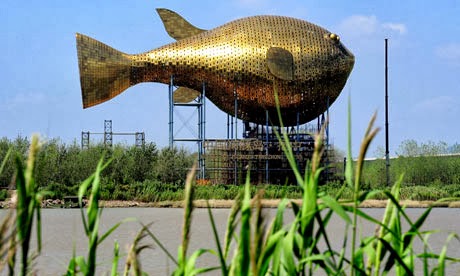
So last week I gave you a taste of Puffer Fish. Was that little morsel a tasty treat, or did it expand and stick in your gullet? Well, you’ll choke on this for sure. The story comes from Yangzhong in in Jiangsu province, China where one of the largest public arts commissions in the world is causing the usual flurry of polarised responses. I say art, but as of this moment, I’ve not been able to find an artists name to attach to it, just that the College of Architecture and Urban Planning School of Shanghai's Tongji University, served as the general contractor, undertaking the entirety of the project from design to construction….some student project eh? First of all the facts: it’s 62 meters tall, 90 metres long and 44 metres wide, it weighs 2,100 tones and was built to mark the opening of a horticultural exhibition. the dear old puffer is decorated with 8,920 bronze plates and multicoloured LED bulbs, which are activated at night. 

The fish is said to cost 70m yuan (£7.1m) and city leaders have applied for a Guinness world record. Ha, big is beautiful eh? 


Local newspaper, Modern Express suggested that the construction process was ‘tainted by corruption – by comparing estimates by construction experts, it found that the statue's raw materials should have cost 10m yuan. "As for what constitutes the other 60m yuan in expenditures, this journalist fails to understand," it said. President Xi Jinping has launched a nationwide crackdown on ostentatious displays of money, which, by highlighting the country's extreme wealth gap, are widely considered a latent trigger of social unrest.’


Last year I wrote a modest response to Olympic histrionics for ixia, Fur Coat and No Knickers. In it, I mentioned the fragile economic state of Spain and specifically Castellon Regional Airport’s sculpture by Juan Ripollés. This €300,000, 24m-high, 20-tone copper statue, dedicated to infamous and allegedly corrupt politician, Carlos Fabra whose gurning, patinated face, welcomes people to the regions brand-new airport, which few people use, in a country teetering on the brink of recession and with the highest unemployment rates in 18 years: surely this is public art at its most banal and most irrelevant? This near totalitarian approach to public art, typified by self-interest and ego, is of course typified in architecture too. We had the Twin-Towers, we still have the Burj Khalifa and now we’ve we’ve got the Shard too - all thrusting their way into the future like some rank Marinetti ejaculate. big, BIG, BIGGER, BIGGEST! 

Thank goodness for the modest small-scale inspirational: the small but perfectly formed Maggies Centers, the street artists, the buskers and the hobbyists - the intimate engagement of the poet, striking a chord when you’re at rock-bottom - and those artists who work with people in settings a million miles away from cathedrals of culture.


I notice that Turnip Prize winning artist, Mark Wallinger unveiled a small-scale version of  The White Horse recently. This will sit outside the British Council’s headquarters for two years before going on international tour. This is a diddy version of his vision for The Ebbsfleet Landmark Project, dubbed by some, the “angel of the south,” its a horse as big as the Statue of Liberty. The costs are believed to be between £12m and £15m. Of course the money promised for the project in 2008 had dried up from its private backers in the wake of the financial crisis.

Just what is the cultural value of these giant monoliths? I know they look brilliant when you see them for the first time, but you’ll need something bigger next time to feed your habit and get your next fix. And how will the ONS measure their impact on people, other than the Viv Nicholson effect? I imagine armies of researchers clutching their questionnaires asking people visiting the beasts, if they feel more inclined to go out and get a job (what job?); if they feel less inclined to self harm and if they just have that lovely warm sculptural-induced euphoria…go on, whip out your own personal hedonometer and check you feel the correct prescribed responses. Or failing that, consume your prescription pills, knock back your cheap booze, down your super-size bargain-bucket and top-up your credit. How did Irvine Welsh put it? (sorry about the clumsy censorship)

“Choose Life. Choose a job. Choose a career. Choose a family. Choose a f****** big television, choose washing machines, cars, compact disc players and electrical tin openers. Choose good health, low cholesterol, and dental insurance. Choose fixed interest mortgage repayments. Choose a starter home. Choose your friends. Choose leisurewear and matching luggage. Choose a three-piece suit on hire purchase in a range of f****** fabrics. Choose DIY and wondering who the f*** you are on Sunday morning. Choose sitting on that couch watching mind-numbing, spirit-crushing game shows, stuffing f****** junk food into your mouth. Choose rotting away at the end of it all, pissing your last in a miserable home, nothing more than an embarrassment to the selfish, f****** up brats you spawned to replace yourselves. Choose your future. Choose life…”


I have a vague unease, that when we anthropods have seen our time through on this little green world, all that will be left will be the traces of giant architectural and artistsic ego - skeletal - but held together by some permanent toxic gunk.


A million miles form Jiangsu province, the northern seaside town of Morecambe celebrates its highest-profile export, through the cultural beatification of comedian Eric Morecambe. Its modest and ugly statue to him, attracts flocks of tourists to pose with their comedy icon, and its claimed, brings much needed revenue to the town. Like a whittled down little version of the Angel of the North in Gateshead, at least this little sculpture has a place in peoples consciousness. Morecambe means something to a few generations of television watchers (and music hall devotees, if you’re still holding on) and the Angel - well there’s a story there steeped in industrial decline and regeneration.


This week, I’m proud to be working in Lithuania and blogging from the beautiful heart of Kaunas. I’m working with friends and colleagues from Socialiniai Meno Projektai on the first artists training programme. This is a real partnership and it builds on the Pathways into Arts and Health training that I’ve delivered over the last few years. It's very hands on and simply builds on the participants skills and desire to work in new ways. This first introductory training will all be based on, and around oncology, and I very much hope will result in some commissioned work for participants. I'll report back on this in full, very soon.


Art for Alder Hey in the Park: Quiet and Reflective Space
Art for Alder Hey in the Park is seeking an artist (or artists’ group) who will consult with staff, parents and children and young people as part of the process to design and make a work of art, and/or series of smaller pieces, for the new Quiet and Reflective Space in the new Hospital. This room will be used by people who have a religious faith, as well as those who do not.
No religious iconography is acceptable, but the art may reflect the environmental/nature theme of the overall programme. http://www.publicartonline.org.uk/whatsnew/commissions/article.php/Art+for+Alder+Hey+in+the+Park%3A+Quiet+and+Reflective+Space 

Art for Alder Hey in the Park: Bereavement Garden
Art for Alder Hey in the Park is seeking an artist (or artists’ group) who will work with the parents and siblings bereavement group, and landscape designer, to design and make a work of art, and/or series of works, for the new Bereavement Garden in the new Hospital. This Bereavement Garden is adjacent to the mortuary and is a space for families who have only just been bereaved and come from the mortuary and counselling rooms.

The Edge Fund Re-Opens for Applications 
The Edge Fund, which was initiated by a small group of philanthropists and activists in early 2012, has announced that that its third funding round is now open for applications. The aim of the fund is to support communities, campaign groups and activists struggling for social, economic and environmental justice. Groups facing discrimination and injustice because of their class, ability, gender, race, religion, sexual orientation, or other factors can apply for grants of up to £5,000 to challenge injustices and create just and healthy communities. To apply, the Edge Fund requires a two page application (max) describing who you are, your group’s annual income, what you do and how you fit the Fund’s guidelines. The deadline for applications is 5pm on 14th October 2013, after which shortlisted applicants will need to provide more details via written, audio or video applications. Read more at http://edgefund.org.uk/ 

Grants to Help New, Innovative Visual Arts Projects 
The Elephant Trust has announced that the next deadline for applications is the 13th January 2014. The Trust offers grants to artists and for new, innovative visual arts projects based in the UK. The Trust's aim is to make it possible for artists and those presenting their work to undertake and complete projects when confronted by lack of funds. The Trust supports projects that develop and improve the knowledge, understanding and appreciation of the fine arts. Priority is now being given to artists and small organisations and galleries who should submit well argued, imaginative proposals for making or producing new work or exhibitions. Arts Festivals are not supported. The Trust normally awards grants of up to £2,000, but larger grants may be considered. Read more at http://elephanttrust.org.uk/docs/intro.html 


Symposium: Sustaining Professional Music in Healthcare Settings Practice 
10am - 4pm, Monday 25th November 2013 
The Education Centre, Royal Derby Hospital, Derby, UK 
OPUS Music CIC, in association with Air Arts to Aid Wellbeing and the Royal Derby Hospital presents a one-day symposium to share, discuss and debate on the topic of Sustaining Professional Music in Healthcare Settings Practice. 
Bringing together key stakeholders including musicians, healthcare professionals, academics and other partners involved in the development of music (and arts) in healthcare settings practice from across the UK and beyond, this symposium will support the generation and sharing of increased understanding, knowledge and ideas required to sustain this practice. The symposium is open to all with an interest in this practice (subject to capacity). 
A charge of £10 per delegate will be made towards the costs of running the symposium. For more information, please contact Nick Cutts, Director, OPUS Music CIC nick@opusmusic.org 


World Mental Health Day
An exhibition of artwork by service users at Birch Hill Hospital. Thought-provoking artwork which explores experiences of mental illness and the care system, whilst challenging some of the misconceptions around mental health. Produced in collaboration with art therapists, artists, designers, photographers and ceramicists, and presented by Pennine Care NHS Trust. More details by clicking on the image above.


...and lest we forget what a beautiful place this earth is, here is a photograph of the Faroe Islands to remind us. Thanks as ever and green, is the warmest colour...C.P.

Selasa, 01 Oktober 2013

Volunteering at Mid Powys Mind

Today Philip Moisson tells us about his experience volunteering at the mental health charity Mid Powys Mind, based in Llandrindod Wells in the heart of rural Powys.


"Of the many organisations that I have worked for over the years the place where I have made the deepest connections with other people has undoubtedly been whilst volunteering at Mid Powys Mind in Llandrindod Wells.

For the past ten months I have been a regular helper in the Art Cafe – which for those of you who have not visited yet combines unique local arts and crafts with a relaxed and homely experience centred around hot drinks and homemade cakes. There are ten or so volunteers currently involved in the Art Cafe and we cover Monday to Friday between us.

The building which Mind uses hosts a drop-in centre for members, the Art Cafe which is open to the public, rooms for groups to meet above the cafe and also spaces for counselling and therapy to take place. There are also a few small offices up another flight of stairs.

As a member and a volunteer I am able to have a hot meal at lunchtime, usually with other people at the drop-in centre. Alongside the Art Cafe there was the chance to try a couple of other voluntary roles around the building, and I can genuinely say that I have looked forward to coming in to help almost every day I have been involved.

Over time I have found out about other opportunities nearby by speaking to other members, other volunteers and of course, paid staff. A few of us have spent quite a bit of time being involved in a Time to Change Wales project (further details on the free Creative Writing sessions can be found here!).

Of all the perks of being involved with a charity, training has to rank quite highly. Some of us have been on the Mental Health First Aid course and a physical First Aid course too. Usually I have a good idea what is going on in terms of the range of courses, services and events which Mid Powys Mind is able to facilitate - in no small part because I update the Facebook page.


Of course, no organisation in the broad mental health sector is immune from the pressures stemming from cuts or from the blunt realities that some of us may refer to in polite or abstract terms through well-meaning debates and arguments. The town, Llandrindod Wells, for all its nearby scenic charm, struggles to offer much in the way of employment opportunity - and that’s whether you have a known mental health concern or not.

However, in terms of focussing on positive outcomes whenever possible, finding a place within reach where people regularly share lived experience with one another has been the most important feature in my own personal journey so far. This will now hopefully involve going forward from a point in the past where I struggled on strong medication with no meaningful support in place, to a position where I am able to live medication free and can fully consider life choices once again."

If you would like to read more of Philip's writings, you can take a look at his own blog, Knowledge of Dark Matters.

Or, if you would like to share your mental health volunteering experience with a wider readership via this blog, and you are based in Powys, then please get in touch.

You can find out more about Mid Powys Mind here.  And congratulations to all those involved in the Art Cafe which was awarded the Group award at the Powys Volunteer of the Year Award recently.

Sabtu, 28 September 2013

BAUBLES, BANGLES and BRIGHT SHINY THINGS


First of all, a huge welcome to Manchester to all of you attending the Conservative Party Conference. Whilst I'm sure the weeks agenda is a full and exciting one, the wonderful world of Arts and Health offers you the most splendid welcome if you'd like to have a conversation about 21st Century well-being and health. Arguably the crucible of this growing global movement that sees culture and the arts playing a critical role in how we put patients at the heart of care. (lets remember the word q u a l i t y) But beyond the expanding and contacting landscape of the NHS, wellbeing is best promoted in all those schools, shopping centres, prisons and streets - the places that we all live our day-to-day realities. So, if you're a member of parliament, a minister of state, a civil servant or an interested other and you genuinely care about health and wellbeing, get in touch and find out more about our offer to you.


I got an intriguing email from the designers, Conway and Young. To mark the 65th anniversary of the NHS; a healthcare system that is free for all at the point of delivery, based on clinical need and not ability to pay - they were speculating what a future NHS might look like. With a chilling provocation, they asked me to imagine, THE YEAR IS 2078 AND THE NHS NO LONGER EXISTS and I was invited to speculate along with 64 other people, what this landscape might look like. I’m not quite sure that I’ve produced what they wanted, but I share with you some dystopian ramblings. I’d like to think of this as the bastard progeny of Jonathan Swift’s economist in A Modest Proposal married to a Riddley Walker aesthetic, with the uplifting people-friendly, feel-good-factor of Soylent Green. Whilst I was able to play with this, I am in debt to Sarah Lawton for her interpretation, her eye for a grand thing and uncanny ability with an A0 printer! A couple of variants will be posted on the blog over the next couple of weeks. I can’t wait to see what Conway and Young entice from other contributors and how they turn all this material around and of course, I’ll link it on the blog when it comes to fruition.


The above image is one of two on this posting by the sublime poet, Robert Montgomery.

Last week, a few people got in touch about the Hidden Mothers images, so this week I can’t resist a friendly little jab at our friends in haute couture who wrap their fetish-based misogyny in grander terms, but don’t half like to hide/olize women too! Here is Jean Shrimpton, courtesy of Avedon. Much as though I'm tempted to post photographs of Femen activists taking to the catwalks - I can't have that one misconstrued! So, just a respectful acknowledgement and a nervous smile.


Just, What do we know about the role of the arts in the delivery of social care?
A new report into the role of the arts within the delivery of social care has been published this week, the culmination of a study commissioned by Creative & Cultural Skills, Skills for Care, and Skills for Care and Development. Catherine Large, Joint CEO, Creative & Cultural Skills, highlighted the need for greater dialogue between the creative and social care sectors: “The care sector needs to recruit an estimated 90,000 qualified workers per year to replace those leaving the sector through retirement and career progression. At the same time, there are thousands of young people graduating from creative arts courses every year who struggle to find employment – surely there is a way we can work together to create meaningful roles for creative practitioners whilst also benefiting those in care settings?”

Download the full report by clicking on the lovely green and unfurling frond.


2014 Hippocrates Prize
With categories for the NHS, young people and an open call, this is a must for poets concerned with health and wellbeing. With a 1st prize for the winning poem in each category of £5,000, the Hippocrates Prize is one of the highest value poetry awards in the world for a single poem. In its first 4 years, the Hippocrates Prize has attracted over 5000 entries from 55 countries, from the Americas to Fiji and Finland to Australasia. Click on the second Montgomery piece below to find out more.


Clore Poetry & Literature Awards
The Clore Duffield Foundation has announced that the sixth funding round under its £1 million programme to fund poetry and literature initiatives for children and young people across the UK is now open for applications. Through the programme, schools, FE colleges, community groups, libraries and other arts/cultural organisations can apply for grants of between £1,000 and £10,000 to support participatory learning projects and programmes focused on literature, poetry and creative writing for under 19s.

The closing date for applications is the 7th March 2014. Read more at: http://www.cloreduffield.org.uk/page_sub.php?id=331&parent=35

I will be out of the county next week, but I hope that the blog will, at the very least, contain a tasty morsel on the humble Puffer Fish. Here's a clue for the public art aficionados, or those of you with an eye for global inequalities.


Nominet Trust Digital Edge Programme 
The Nominet Trust has announced that the next advisory closing date for its Digital Edge programme is the 27th November 2013. The Digital Edge programme aims to support projects that use new technology to engage young people in new, more meaningful and relevant ways and enable their participation in building a more resilient society.  There is no upper or lower funding limit as the Trust like to encourage applicants to be realistic about what they need to achieve their project objectives. The Advisory Stage 1 date is set to allow enough lead time for successful applicants to have sufficient time to complete their Stage 2 application. There is also a final deadline date for Stage1 applications; any applications received after this date will not be included in the current funding round. The final deadline for applications is the 11th December 2013.  http://www.nominettrust.org.uk/how-to-apply/areas-investment/digital-edge


This little wood engraving is by the minor artist John Farleigh and is called melancholia. I include it simply because sometimes, artists just get it so, so right.   Thanks as ever...C.P.

Rabu, 25 September 2013

Unconventional Wisdom: Organic Reasons for Depressive Symptoms


As many readers will know by now, I think we need to be challenging and debating the logic that accepts “mental illness” as a valid concept.  I am concerned that our mainstream acceptance of the idea of “mental illness”, within our health and social care services, our mental health laws and our society, leads us to act in ways that, although well intentioned, cause bad consequences.  Ultimately this may result in more harm than good for people affected by the idea that experiences and actions can be diagnosed as "symptoms" of “mental illness”. 

Last Thursday, in our “Shaping Services Together” Conference, I think that we succeeded in furthering this debate in Powys (watch this space for upcoming blogs that will tell you more about that event.)  With the help of Jacqui Dillon and Jo Mussen the morning started with us being asked to consider the following question:  

“Should mental health services be shaped by the question what happened to you rather than what’s wrong with you?” 

In this vein, I want to continue the theme from my last blog about organic reasons for psychosis by exploring organic reasons for depressive symptoms, again to try and make sure that:

In our drive to suggest that people are asked "what has happened to you" rather than “what is wrong with you”, let's not miss the question “is there anything physically/organically wrong with you?” 

Map of Medicine, which is the NHS system that claims to provide access to comprehensive, evidence-based guidance and clinical decision support, lists the following as typical symptoms of depression:
  • an unusually sad mood that does not go away 
  • loss of enjoyment and interest in activities that used to be enjoyable 
  • tiredness and lack of energy 
  • crying spells, withdrawal from others, neglect of responsibilities, loss of interest in personal appearance, loss of motivation 
  • chronic fatigue, lack of energy, sleeping too much or too little, overeating or loss of appetite, constipation, weight loss or gain, irregular menstrual cycle, loss of sexual desire, unexplained aches and pains
A diagnosis of depression by a medical professional (in the case of depression, most often made by GPs) will be based on the number of these symptoms that you are experiencing/exhibiting, and whether you have experienced the symptoms for at least two weeks.

What are the known organic causes of these typical depressive symptoms?


Firstly let me try and clarify that by organic causes of depression I mean where the depressive symptoms are the direct result of an organic cause.  I do not include conditions where it is the actual coping with the organic condition, such as  cancer, dementia, heart disease, that results in us experiencing emotional stress and natural feelings of hopelessness, despair, loss of enjoyment and tiredness, feelings that could be diagnosed as “depression”.  Instead I am trying to find out about organic/biological conditions that cause a change in our physiological functioning that lead to the symptoms of depression that I  listed above. 

The Clinical Knowledge Summary from the National Institute for Health and Social Care Excellence (NICE) lists the following as organic reasons for depressive symptoms:

  • Carbon monoxide poisoning   
  • hyperthyroidism and hypothyroidism – state in which the thyroid gland production of thyroid hormones, thyroxine and triiodothyronine, is abnormal
  • Rare side effects of prescription medication, such as: 
    • antihypertensives used to treat high blood pressure 
    • lipid-soluble beta used to treat a number of conditions including heart disease and high blood pressure 
    • central nervous system depressants used to slow down brain activity prescribed for conditions including insomnia, muscle tension, pain, epliespy, anxiety and mood “disorders” 
    • Opioid analgesics, generally uised for pain management 
    • Isotretinoin primarily used for acne
However,as with my blog on organic reasons for psychosis, other organic reasons for depressive symptoms are to be found elsewhere on NHS sites.  These include:
  • Cushing's syndrome, caused by very high levels of a hormone called cortisol 
  • Hypercalcemia caused by abnormal levels of serum calcium concentration.  Also a complication of Pagets Disease 
  • Hyponatremia where sodium ion concentration in the plasma is lower than normal 
  • Diabetes when the pancreas does not produce enough insulin to maintain a normal blood glucose level, or your body is unable to use the insulin that is produced 
  • Neurologic disordera such as Epilespy, Stroke, subdural hematoma, multiple sclerosis, brain tumors (especially frontal), Parkinson's disease, Huntington's disease, epilepsy, syphilis, dementias 
  • Nutritional disorder such as Vitamin B12 deficiency, pellagra caused by a chronic lack of niacin (vitamin B3) 
  • Other disorders such as viral infection and carcinoma
How do these organic/biological causes result in us experiencing depressive symptoms?

In many different ways it seems.  Some of the physical conditions listed above result in an imbalance of the hormones that we need to keep our bodily process working efficiently (e.g. thyroid hormones, insulin, cortisol).  When our hormone production or our ability to effectively use these hormones goes wrong, then a direct result can be symptoms of low mood, lack of enjoyment, tiredness, mood swings and lethargy.

Some of the conditions listed above cause damage to our brains in the areas that are know affect our mood so again the effect of this damage results directly in depressive symptoms. 

When someone experiencing depressive symptoms presents to a health care professional, what investigations will occur to determine whether there is an organic cause?

So back to the NHS Map of Medicine then.  It states that people presenting to health professionals with suspected depression may, “depending on the judgment of the clinical professional of the nature of their presentations”, expect to have medical investigations done to rule out an organic cause for their depressive symptoms.  The investigations are listed on this site but they include biochemistry tests, such as blood glucose, liver function tests, thyroid function tests and hematology tests such as full blood count.

Can depressive symptoms be misdiagnosed as a "mental illness" in this case “depression” when they are actually caused by organic/physical conditions? 

Unfortunately it seems that the answer to this is yes, again as it was with psychotic symptoms.  It is not difficult to find examples of organic problems being misdiagnosed as “depression” from across the academic world, the press and from people’s stories.    So examples where someone is diagnosed with "depression" and treated for this first, rather than the organic reason being found and appropriate treatment for the biological condition being given (e.g. removal of brain tumor, treatment for Hyperthyroidism).  

How often can the psychological symptoms we experience actually be explained by organic/physical/medical reasons? 

There is of course a lot of information about this on the internet but I really am not sure we know the definite answer to this.  It seems that a conservative estimate that about 10% of all psychological symptoms may be due to medical reasons, as this study suggests.   However the results of one study suggest that about 50% of individuals with a “mental illness” diagnosis actually have general medical conditions that are largely undiagnosed that may cause or exacerbate psychiatric symptoms.

So over to you again. Can you help me answer these questions?  Are they questions worth asking?  Tell me what you think ...


  • Should mental health services be shaped by the question what happened to you rather than what’s wrong with you?
  • In our drive to ensure that people are asked "what has happened to you" rather than “what is wrong with you”, lets not miss the question “is there anything physically/organically wrong with you”.
  • What are the known organic causes of typical depressive symptoms and how do these organic causes make us feel “depressed”?
  • When someone experiencing depressive symptoms presents to a health care professional, what investigations will occur to determine whether there is an organic cause?
  • Can depressive symptoms be misdiagnosed as a "mental illness" in this case “depression” when they are actually caused by organic/physical conditions?
  • How often can the psychological symptoms we experience actually be explained by organic/physical/medical reasons?